
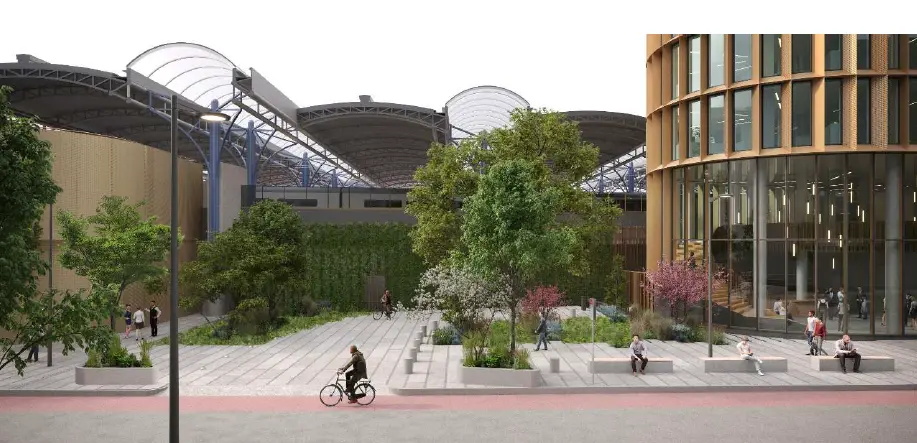
Construction of Infrabel's New Headquarters: Environmental Impact Assessment
Stratec was commissioned to carry out an environmental impact assessment (EIA) in the scope of a urban planning and environmental permit application concerning the demolition of 3 existing buildings and the construction of Infrabel’s new headquarters.
Location: Brussels-Capital Region (Saint-Gilles)
Client: Infrabel
Date: 2023-2024
Photo credits: Artbuild Architects, Gortemaker Algra Feestra
Context and Objectives
Infrabel currently occupies several buildings in the immediate vicinity of the Brussels-Midi Station, some of which are leased from SNCB. The leases for these spaces expire between the end of 2025 and 2027. To unify its workforce, streamline processes, and integrate technology while addressing evolving operational demands, Infrabel is set to construct a new corporate headquarters.
The project involves the construction of a complex of three office towers, 27m, 40m, and 60m in height, for a total floor area of approximately 35,000 m². The proposed complex combines various functions such as premises for railway traffic management, technical rooms, and offices.
The objective of the Environmental Impact Study is twofold: to evaluate and characterise the project’s impacts on various environmental domains (urban planning, landscape, mobility, noise, fauna, flora, air quality, soil and water, etc.) and to formulate recommendations aimed at avoiding, reducing, or compensating for the project’s negative effects on the environment.
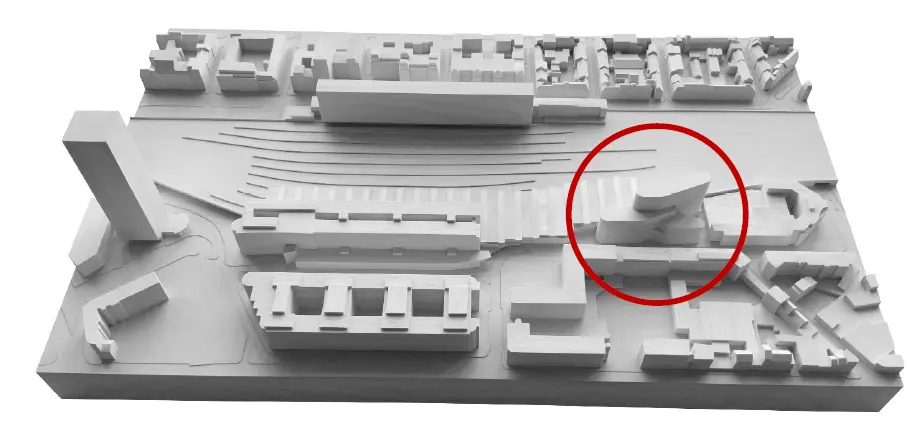
Key Analysis Points
Mobility: Stratec quantifies the traffic generation linked to the project’s development and studies its impacts on surrounding mobility networks. Stratec also studies the adequacy between supply and demand for parking for vehicles (including many company cars) and bicycles.
Urban Planning and Landscape: The study analyses the landscape and functional integration of the project into the Brussels-Midi Station district and Rue de France. Various alternatives, particularly concerning the building’s size and the project’s program, are examined.
Soil and Water: The study evaluates the project’s imperviousness rate and the relevance of the planned rainwater management systems, taking into account the site’s characteristics, such as the shallow groundwater table and the passage of the Senne river under Rue de France.
Construction Phase: The construction of this project is more complex than a conventional construction site due to its proximity to the railway line (international tracks) and Rue de France. The project’s construction footprint encroaches on half a lane of Rue de France. Several scenarios are therefore being studied to propose a new traffic plan during the construction phase and a modification of the existing parking on Rue de France.

Contact
Questions, specific needs? Speak to our expert now
- Pierre-Yves Ancion
- Py.ancion@stratec.eu
- Head of Studies
- +32 2 738 78 73